Issue № 8 · Story III
Collars
Dakar, the last night before Tabaski. Of the sixty sheep Hamady brought down from Kébémer, forty-nine are sold and wearing a cloth collar with a name on it. Eleven are not, seven of them his brother’s, and the verge has agreed on a price. A watchman in a borrowed jacket keeps coming back with the number he has.
Of the sixty sheep Hamady had brought down from Kébémer, forty-nine were sold, and on the last night before Tabaski forty-one of those were still in his pen with a collar on.
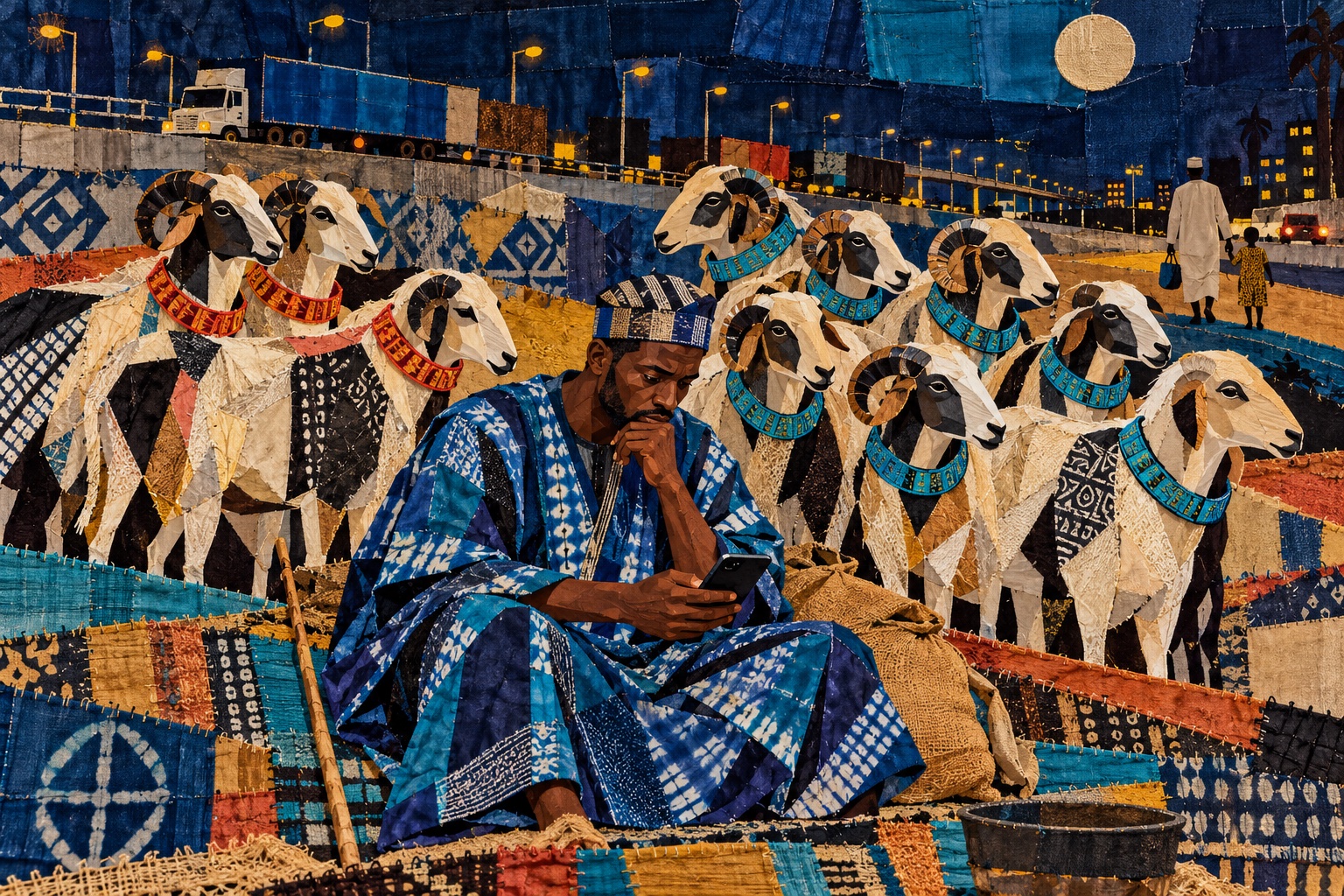
The collars were strips torn from a roll of cloth his brother’s wife had sent down with the truck. Red for paid in full, blue for half. On each one Hamady had written a name in marker as the money came in. Diallo. Mme Sarr. Pape Ndiaye Liberté 6. The men who had bought them lived in flats with no room for a sheep, so the sheep stayed on the verge with the man who had sold them, eating his hay and drinking his water, until the last night, when everyone came for them at once.
Eleven had nothing round their necks. He could have found them in the dark.
The selling point was a strip of sand along the VDN between a petrol station and a wall with nothing behind it, and it had been his for eleven days. Six herders had pens there, fenced with rope and pallets, lit by a single bulb run off the petrol station’s supply at a price the attendant set fresh every evening. Old Ka had the end nearest the road because he had been coming to this verge since before the road was widened. Moussa, who was twenty-two and on his first year down, had the end nearest the wall.
By sunset the whole city was on the road. Knife grinders pushed their wheels along the kerb and set up under the streetlights, sparks going into the dust. Boys sold charcoal by the sack and onions by the net and skewers and rope and fans. A pickup crawled past with a ram standing in the back like a man on a bus.
Seven of the eleven were Demba’s. His brother had bought them as lambs in the rains and fed them through the dry months on his own money. He had put them on the truck with Hamady’s four because one man selling eleven looks steadier than two men selling four and seven. The smallest was a hundred and seventy-five thousand. The best of Demba’s was two hundred and fifty. Demba had rung on the first day to say two things. Don’t come back with sheep. Don’t come back cheap. He had rung at four o’clock that afternoon and said them again, as if hearing them twice would make them fit together.
At seven a man in a good shirt walked the length of the pens offering a hundred and forty for anything uncollared. He was polite about it. He said it at each pen and moved on to the next one. When he had gone, Ka said, to the air above his own sheep, “He’s waiting for us to get tired.”
Nobody went to a hundred and forty. That was all the agreement there was on the verge, and for eleven days it had been enough.
Hamady knew inside a minute who could pay. A man who could pay put his hand flat on the sheep’s back and ran it down the spine, feeling for fat, and then lifted the lip and looked at the teeth. A man who could not pay looked at the sheep’s face.
The watchman came at nine. He wore a guard’s jacket two sizes large with a security firm’s badge on the arm and a name tape on the pocket that said DIOP. He greeted Hamady properly, “Salaamaalekum,” and waited for “Maalekum salaam” before he said anything else, and then he looked at the smallest of the uncollared sheep, at its face, for a long time.
“How much?”
“A hundred and seventy-five.”
“A hundred and twenty-five,” the watchman said. It was the number he had.
Hamady said a hundred and seventy-five again. The watchman nodded and went back up the verge toward the traffic.
Then the taxis came.
They came in a line that stopped the inside lane, yellow and black, hazard lights going, and the drivers leaned on the horns while their fares went pen to pen with their phones out. Hamady untied collars and matched names to faces and took the second half on the blue ones, some in notes and more by Wave, a man holding his screen up in the dark until Hamady’s phone buzzed. The sheep went into boots with the lids tied down on string. They went on roof racks with their legs hobbled. One ram went into the back seat of a Peugeot between two boys who held it by the horns and laughed the whole time the car was pulling out.
By eleven he had twenty-six collars left in the pen and a quarter of the forage gone and a sound in his ears he would have for two days.
At midnight the news came up the verge that a lorry from Mauritania had unloaded at the point toward Yoff. Thiogol, small animals, ribs showing, a hundred thousand a head. Everyone on the VDN said you could tell a thiogol from across a road, and everyone said the Dakar people could not.
Moussa came to Ka’s pen and stood there. He did not say a hundred and fifty.
“Go to a hundred and fifty, then,” Ka said.
Moussa went back to his own end and did not.
The truck driver came round after that with his price for the road north. Two hundred thousand to Kébémer, he said, whatever was in the back. He was sorry about it. There was nobody coming south on the morning of Tabaski to pay for the other direction.
The watchman came back at one.
“A hundred and twenty-five,” he said.
In eleven days Hamady had heard every story that goes with that number. A mother in a room in Pikine. A daughter’s naming ceremony. A brother in the hospital at Fann. He had a price for each of them, and it was the same price, and he had never once had to decide who was lying. It did not matter. This man told him nothing. He stood in the light from the bulb in somebody else’s jacket and said his number and waited.
“A hundred and seventy-five,” Hamady said.
The watchman went.
Hamady did the arithmetic again, as he had done it every hour since four o’clock. If he held, he took eleven sheep north. Two hundred thousand for the truck, and then hay until somebody’s baptism or somebody’s wedding needed a ram in a month when nobody was buying rams. Demba’s seven would go back into Demba’s yard and eat Demba’s money. If he cut, he could go to a hundred and fifty before light and sell four, maybe five, to the men who came late on foot. Every pen on the verge would have it by the dawn prayer. Next year the man in the good shirt would walk the pens on the first day, not the last.
At two a man came down the verge on foot with a boy of about twelve. He had come from somewhere with a jacket and tie and had taken the tie off. He did not look at the faces. He went into Hamady’s pen, lifted the lip of the smallest of Hamady’s own four, and stood up.
“A hundred and fifty,” he said. “Now.”
It was a real offer. The notes were in his shirt pocket, and the boy already had the ram by one horn.
A hundred and fifty was twenty-five under what the verge was holding. It was also a hundred and fifty more than the ram would be worth in the back of a truck on the road north, and Hamady had done that sum as well. Four pens down, Moussa had sat up on his mat.
“A hundred and seventy-five.”
“A hundred and fifty.”
“A hundred and seventy-five.”
The man nodded, took the boy’s hand off the horn, and went on up the verge toward Ka’s pen, where Ka said something short, and then toward the wall. Hamady did not watch to see where they stopped. A little later he heard the boy laugh somewhere down at Moussa’s end.
At three the verge was quiet. Most of the collars had gone. The herders lay on mats between their pens with their phones on their chests. Ka was on his back with his eyes open.
The watchman came back down the verge. He had been walking. His trousers were grey with dust to the knee.
“A hundred and twenty-five now,” he said. “The rest at the end of the month.”
The end of the month was when a man in a jacket was paid.
Hamady looked at him. He knew the man could not pay the rest, as he had known it at nine o’clock, by the face and the hands. He also knew what fifty thousand on a telephone number was. If it came, he had sold at a hundred and seventy-five and cut nothing, and nobody on the verge could say otherwise. If it did not come, he had sold at a hundred and twenty-five to a man with no money, which was the only cut on the VDN that night that would bring him nothing back.
He did not look at Ka.
He went into the pen and took the smallest of Demba’s rams by the horn and brought it out.
The watchman counted the notes out of a brown envelope with his employer’s stamp on it. Hamady counted them again. A hundred and twenty-five. Then he held out his phone. The watchman typed a number into it and rang it, and the phone in his own pocket buzzed once and was quiet. That was the contract.
“Name?”
“Diop,” the man said, and touched the pocket, and then took his hand away. “No. Faye. Ibrahima Faye. It’s my cousin’s jacket.”
Hamady typed Faye. There was no cloth left for a collar. He gave the man a length of rope. The man put it over the ram’s head and walked it up the verge toward the road, where there were no taxis now, and turned north along the kerb with the sheep beside him at a sheep’s pace.
They prayed at first light on the mats, the six of them in one line on the sand with the pens behind them. Ka was on his right. When it was done Ka rolled his mat and stood with it under his arm. He looked into Hamady’s pen and counted, as any herder counts another man’s pen, without seeming to.
“Ten,” Ka said.
“Ten.”
Ka nodded and went to wake the driver.
They loaded from the pallets. The driver backed the truck onto the sand and dropped the ramp and Hamady walked them up one at a time, his four and Demba’s six, and the driver roped the gate. The VDN was empty in both directions. Somewhere behind the wall a man was sharpening a knife and testing it, and a radio in the petrol station was giving the time of the prayer at the Grande Mosquée.
He climbed into the cab. The seat was warm already.
Two hundred thousand to the driver, out of the money from the collars. Ten sheep in the back to feed until somebody married. A hundred and twenty-five thousand in his shirt that was Demba’s. And fifty thousand that was a name and a number in his phone, which was Demba’s too, and which he would have to explain to Demba somewhere between here and Thiès.
♥ 2026 Paul Titangos · CC BY 4.0 · a story from Good Day Mockingbird № 8