Issue № 8 · Story I
The Reserve
Mexico City, the last five days of October. The Barreras sell a year of cempasúchil in a week, all of it, except the forty best stems under the table, which go home for the family’s own dead. Then a man from a hotel sees the blue bundle, and Lucero, who keeps the book, knows exactly what his number would pay for.
The truck came down off the causeway into the city before light on the twenty-eighth of October, riding low on its springs, the whole cut of the south chinampa breathing in the dark behind the cab, and from that hour until the second of November nobody in the Barrera family slept lying down.
This is the arithmetic of the flower, and Lucero had known it before she knew her letters. Cempasúchil is sown in June, by San Juan, on faith and forecast. It drinks all summer at the family’s expense. Then it must be cut, carried, and sold in the last five days of October, all of it, the entire year, because on the third of November a truckload of marigolds is a truckload of compost and everyone on both sides of the table knows the hour of the conversion. A whole year of income with a five-day shelf life. Other families at the Jamaica market sold roses, gladiolas, baby’s breath, things with a calendar. The Barreras sold one week. They were, her father liked to say, the most seasonal people in Mexico.
By noon of the twenty-eighth the stall was a wall of orange, buckets three deep, bunches stacked in courses like masonry, and the smell had moved in for the week, green and bitter, a smell with elbows. Her mother, Irma, ran the front. Her father, Tacho, hauled from the truck and slept in it, in the seat, upright, with the money belt under his shirt. Lucero counted change, retied bunches, and kept the book. The market did not close that week. At three in the morning it only lowered its voice.
Under the table, wrapped in the blue rebozo, lay the reserve.
Forty stems. The best forty of the year, cut last, cut longest, the tall criollo kind grown from seed the family had saved since before the seed companies got into the business, heads the size of oranges and that dark fire color the new hybrids never quite manage. The forty did not have a price because they were not stock. They went home on the second for the mesa, for the family’s own dead, and this was Abuela Chela’s rule and older than anyone who had to follow it. Sell the field, she said every year. Sell the seed if you have to. The mesa’s forty come home.
This was the first year the rule traveled without her. Ninety now, and her hips done with cities, she had stayed in San Gregorio to build the arch of carrizo in the yard and wait for the flowers to come to her, and her absence rode along all week like a passenger nobody mentioned.
The peak does not arrive politely. It accumulates. The twenty-ninth was brisk, the thirtieth was heavy, and by the thirty-first the aisle in front of the stall was a single slow animal made of shoulders, and the price of a bunch had doubled since Tuesday and was climbing by the hour, the way it did every year, need and the calendar squeezing the market between them. There was too much of everything and not enough time to sell it in. Too much money, even. It stopped fitting in the coffee can by the thirty-first, and Irma banded it into bricks, and the belt under Tacho’s shirt made him look prosperous and feel hunted. Sleep came in forty-minute pieces. Lucero stopped being able to taste the coffee on the thirtieth and drank it anyway, for the heat of the cup.
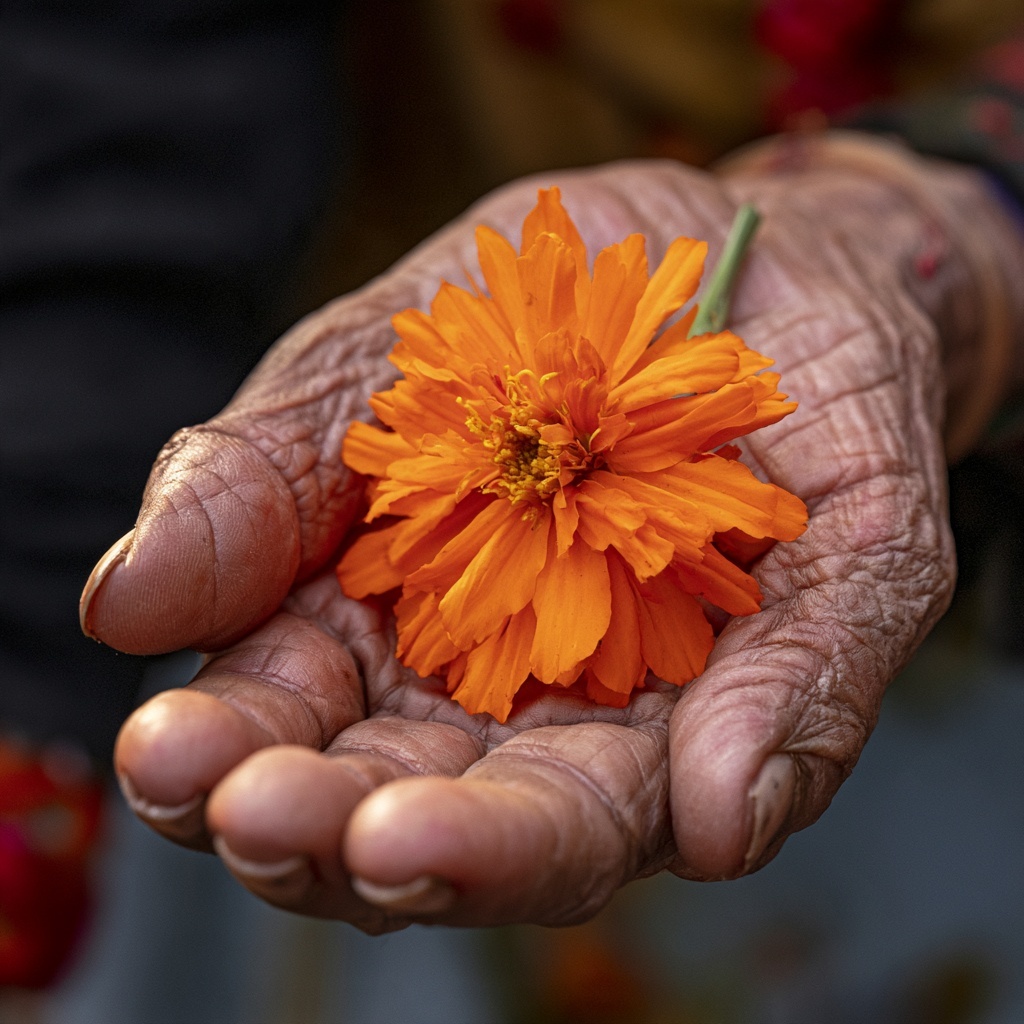
The week collected its usual tolls. In the small hours of the thirtieth, while Tacho slept sitting up, somebody walked off with two full buckets, sixty bunches, gone into the dark between one coffee and the next. Irma wrote it in the book as wind and said nothing else about it, which was worse than shouting. That afternoon a woman held a petal up to the light and announced to the aisle that they dyed them now, that the true color had died with the old seed, and Irma pulled one tall criollo from under the counter, snapped the stem, and held out her own palm, stained orange since the cutting. Grown in it, señora, she said. Same as us. The woman bought four bunches. The market ate their voices anyway, hers and Tacho’s both, so that by the first of November the two of them were trading in whispers and pointing, rich and rasping and gray in the face.
The man from the hotel came first on the thirtieth, clean shoes, linen jacket, a clipboard. He was dressing the lobby and courtyard of a place in Polanco for a Noche de Muertos event, la experiencia, he called it, and he bought big and paid the asking price without haggling, which unsettled Irma more than any haggler ever had. He photographed the stall from three angles. He asked to photograph Irma’s stained hands for the mood board, and Irma said the hands cost extra, and he laughed and paid it, and she folded the bill away and did not laugh.
Then he saw the blue bundle under the table. He had an eye, that was the thing. Among ten thousand flowers he saw the forty that weren’t for sale.
Those, he said. The tall ones. The real ones. Those are exactly what the designer wants for the entry arch.
Not for sale, Irma said.
He offered on them anyway, that day and again the next, and the number doubled between visits the way everything doubled that week. Lucero heard both offers. She kept the book; she knew what the numbers meant. Under her cot at home was an envelope with Querétaro written on it, the semester, the room, the bus, the books, and the envelope was still a hand’s width short, and the second offer on the forty would have closed it with room to spare.
She said so on the evening of the first, in the thick of the last rush, and she did not say it quietly.
Sell them to him, mamá. They’re flowers. The field grew ten thousand of them and the dead get all of it and I’m asking for forty.
They’re the mesa’s, Irma said. You know whose they are.
Bisabuelo is dead, Lucero said, loud, over the counter, over the customers, loud enough that the neighboring stall turned. The dead get the smell of it either way. That’s what an ofrenda is, it’s the smell. He’ll have his either way. I need the thing itself. You’ll kneel on the second with full hands and send me to Querétaro in January with empty ones.
The aisle kept moving. Somewhere down the row a vendor called prices without breaking stride. Irma looked at her daughter for a long moment, wet-eyed and stone-faced at once, and said, in the whisper that was all the market had left her, Mind the front, and went to the truck, and did not speak to her again for an hour.
What she did at the end of that hour she did herself, and told no one first.
The man from the hotel came down the aisle on his third pass at nine, hopeful as a gull, and Irma raised two fingers and called him over. She made him say the number again, out loud, in front of the stall and the neighbors and God, and then she made him say it a second time while she watched his face, and then she brought out the rebozo and unwrapped it on the counter, and the forty lay there glowing under the bulbs, dark fire, heads like oranges, the best forty stems in the market and everyone nearby knew it on sight.
She counted them into his arms one at a time so he would understand the count was exact. He asked, giddy, whether she’d sell the shawl as well, for the display, for authenticity.
No, Irma said, and folded it, and put it away.
He paid in new bills. Irma banded them separate from the bricks, walked back to where Lucero stood with the book, and set the packet on the open page.
Don’t thank me, she said. Write it down.
Lucero wrote it down. Sale, forty stems, criollo. The book did not have a column for the rest of it.
They sold to the walls on the second’s small hours, sold the last loose bunches at dawn for whatever was offered, broke down the stall, and drove south out of the city with the truck riding high and empty and the money belt riding low and full, into the cold yellow morning of the Day of the Dead, the one day of the year the Barreras had ever been late to, every year, always, the price of being the people who sell the flowers. Other families’ ofrendas went up on the thirty-first like lamps being lit down a street. Theirs went up on the second, in the afternoon, out of whatever had come home.
This year what came home was culls. Two buckets of broken-stemmed ones, crooked ones, small-headed ones the market wouldn’t take, kept all week for the path the way you keep bent nails.
Chela was in the yard when the truck came through the gate, sitting by the bare carrizo arch with her hands in her lap. She watched them climb down. She saw the buckets. Then she saw the rebozo, folded flat and empty on Lucero’s arm, and Lucero watched her grandmother understand the whole week in one look, the theft, the prices, the man with the clipboard, the envelope, all of it, the way old women read a folded cloth.
Chela took the rebozo from her and hung it over her own shoulder and did not ask one question. That was the punishment, that she didn’t ask. She turned and started giving orders about water.
They built it together through the afternoon, the three women and Tacho asleep on his feet, and it was a culls ofrenda from top to bottom, crooked stems wired to the arch in pairs to make full heads of half ones, small flowers packed tight where big ones should have stood alone, the path to the door laid in loose petals because loose petals were what there were. They set the photographs in their places, the bread, the salt, the water, the little glass of mezcal for bisabuelo, who had also sold flowers in this market of a country, and had also, family legend said, once sold the coat off his own back in a good hour and walked home cold.
It held. It looked, by candlelight, like plenty. That was the thing Lucero kept turning over while the copal smoke climbed through the bitter orange smell and the candles came up one by one in the blue evening. The arch stood. The path glowed. The dead, if they came, came down a road of seconds and broken stems, and nothing in the yard suggested they minded, and she could not decide, standing in it, whether that made what she’d argued for better or worse. They had sold the best of the year to dress a lobby in Polanco and kept the culls for their own dead. The envelope under her cot was full. Both things would still be true in the morning.
Chela said one thing the whole evening, at the end of it, taking Lucero’s stained hand in her two dry ones, not unkindly, looking at the orange grained into the knuckles.
In June you’ll plant your own row, she said. Past the willows, where your bisabuelo’s was. The forty come out of your row now.
The dye stayed in Lucero’s hands into December, fainter and fainter. Some mornings in Querétaro, in the cold, in the paid-for room, she caught herself holding them to her face, checking, the last of the year coming off her skin, the part of the crop that had come home with her, the part the dead get.
♥ 2026 Claire Jacobs · CC BY 4.0 · a story from Good Day Mockingbird № 8