Issue № 9 · Story II
Outstanding
Reno, Nevada, 1986. Rita counted the MGM Grand’s chips in before a single one had been bet, a million dollars in clay with a lion on every one. Eight years later the hotel becomes Bally’s, the lion comes off everything, and the old chips get ninety days to come home to her window, one to one, no exceptions. A hundred and ninety-one thousand dollars is out there, and Marv, with a cigar box and a folding stool, is setting his own rate on the public side of the rope.
I counted the money before it was money.
That was April of 1978, three weeks before the doors opened. The MGM Grand was a gravel pit on East Second Street when they started it and twenty-six stories when they finished, three miles out from downtown, with a jai alai fronton on one end that nobody in Reno could pronounce and a theater on the other that was still waiting for its airplane. I was twenty-seven. I had been a change girl at John Ascuaga’s Nugget for four years, with the apron and the belt, and I could count a roll of quarters by the weight of it in my hand. The MGM hired me into the cage because I could count, and the first thing they gave me to count was the chips.
They came in from the manufacturer in cases, and they had never been bet. Nobody had sweated on them. Nobody had stacked them and knocked them over. Four of us sat in the vault for six days and broke them out into racks of a hundred, five rows of twenty, and counted every rack twice, and stacked the racks on the steel shelves by color, and a lion looked up at me out of every one of them. Blue ones. Red fives. Green twenty-fives. Black hundreds, which I had never held a hundred of at once. By the end of the week there was a million dollars in that room in face value and not a dollar of it was real yet, because nobody had bought one.
A chip is a promise. You give the house a dollar and the house gives you a disk of clay that says it owes you a dollar, and when you want the dollar back you come to my window and I give it to you. The house makes the promise. I keep it.
I did that for eight years. I kept the drawer and then I kept the shift. The cage balances or nobody goes home, and in eight years I went home every night.
On the sixteenth of November, 1985, Lyle Bosch came into the cage with the Gazette-Journal folded open to the story and put it down on the counter in front of me where a customer would put a chip.
Bally Manufacturing. The slot machine people. Four hundred and forty million dollars for both MGMs, ours and the one in Las Vegas. Lyle had been cage manager since the opening. He explained things to you as if they were a change in the parking and then stood there until you worked out that they weren’t.
“It’s a name,” he said. “Kerkorian keeps the lion. He’s not selling the lion. So the lion comes off. The sign, the matchbooks, the napkins, the keys, the dealers’ tags. The carpet, when they get to it. And the chips.”
“All of them?” I said.
“Every chip in the building, and every token in every slot machine on the floor. Carson City approves a design, and then they give us a date, and that night the whole floor turns over.”
“And what happens to the old ones?”
“The old ones get a window.”
He hadn’t been told yet what the window would be, and when he was told, in March, it was ninety days. Ninety days from the switch, the old chips came to the cage for exchange, one for one. After ninety days, Lyle said, a lion chip was a souvenir, not money.
I asked him the number, because the cage keeps the number. The house carries every chip in the world as a debt. Every chip that’s out there in a pocket or a sugar bowl or a dead man’s suit in Winnemucca, we owe a dollar on, or five, or a hundred, and the figure is on the books, and the cage knows it to the dollar at the end of every month. It’s called the outstanding.
“Hundred and ninety-one thousand,” Lyle said. “Give or take. That’s what’s out.”
“And what is it after ninety days?” I said.
“After ninety days,” Lyle said, “whatever hasn’t come home is ours.”
He said ours. He had never once said ours about a dollar in that building in eight years.
I made seven dollars and forty cents an hour. But I had counted those chips in. I had sat in a room with them for six full days before anyone had bet one, and for ninety days in 1986, I was the only person on the house’s side of the counter who wanted every last one of them to come home, and I could not have told you why.
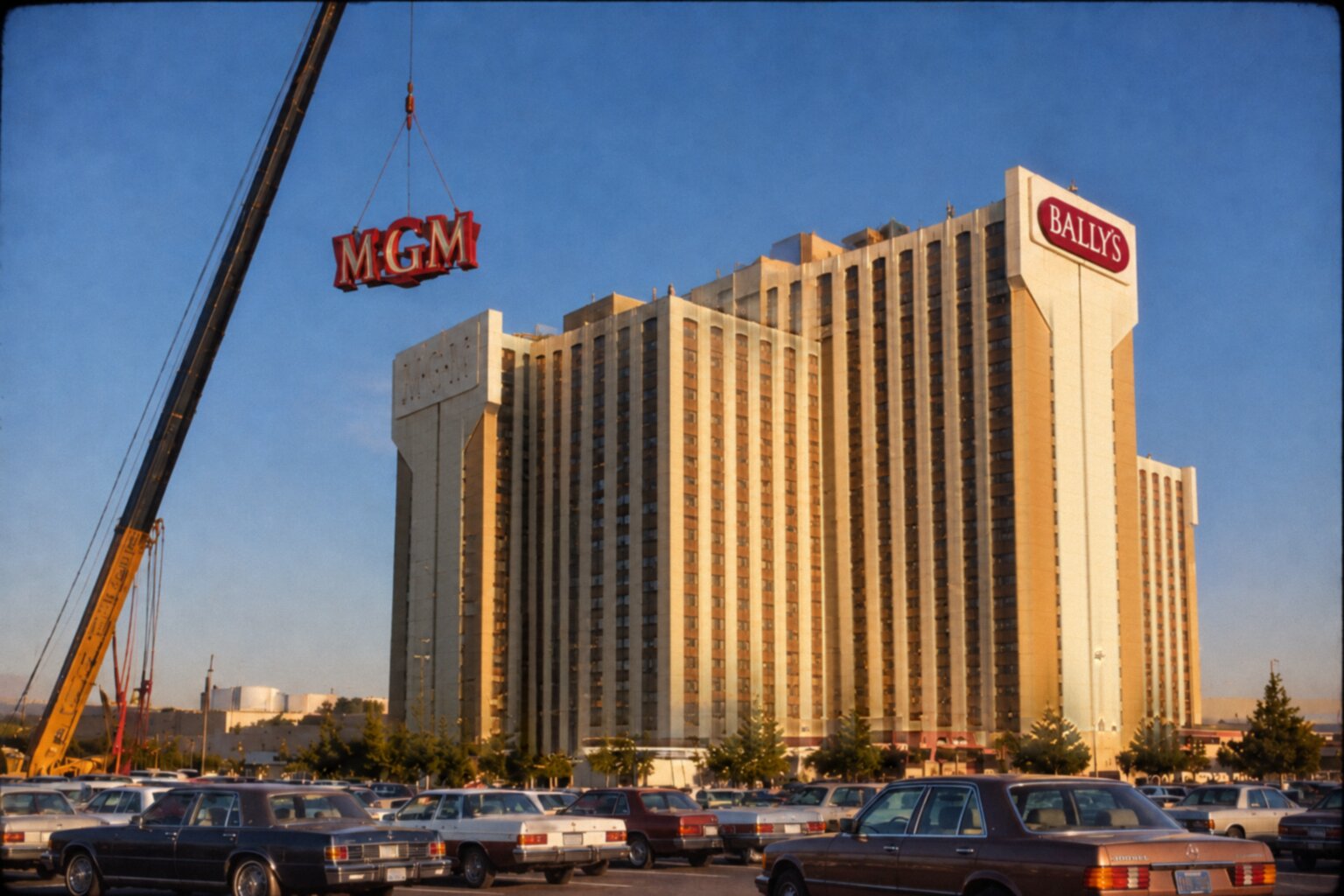
The switch was in April. The sign came down with a crane one afternoon and went up again that night saying BALLY’S RENO, and the show went on at the usual time with the airplane in it, and the casino did not close for one minute, because casinos never close.
What you do is this. At four in the morning, when the floor is as empty as it gets, two of us go out from the cage with a rolling cart and a security guard to the first table, and we do a fill, which is money going to a table, and a credit, which is money coming back, at the same time. The new chips go into the dealer’s rack. The old chips come out. The pit boss signs. The dealer signs. I sign. The guard signs. Then the next table. It took two nights, and the whole time there were people at the tables, and a man with a red five of the old kind was told, very politely, that he could play it, and he could, and when it came back to the dealer it went in the drop and never came out on the floor again.
The new chips were the same colors as the old. Blue ones, red fives, green twenty-fives, black hundreds. The house mold instead of the lion. And a purple five-hundred I had never had reason to see before, with a pattern in it that you couldn’t see at all in the light and that lit up and said BALLY’S, over and over, under the ultraviolet lamp we kept in the cage for the hundred-dollar bills. Lyle showed me that one himself. He was pleased with it.
The slot tokens took weeks. Every machine on the floor, every hopper, every token with a lion on it out and a token without one in, a man with a key and a bucket going down the rows all through May. The matchbooks were gone by the second day. The carpet had lions in it for six years.
The old chips came back to the cage on the carts and went into the vault, on the same steel shelves, in the same racks, and I counted them in again, for the second time in my life, and this time they were sweated on and chipped at the edge and smelled like a casino.
I lettered a sign and put it in the window. MGM GRAND CHIPS REDEEMED AT FACE VALUE THROUGH JULY 25, 5 P.M. ONE TO ONE. NO EXCEPTIONS.
They came for ninety days.
Consuelo from the tower came the first week with a hotel coffee cup, the kind with the lion on it, with thirty blue chips in it that she had found under beds and in nightstand drawers over eight years, and one green one taped to the underside of a nightstand drawer, where somebody had put it on purpose and she had found it the day the drawer came all the way out, and that were all supposed to go to lost and found, and had gone into a coffee cup in her locker instead. She put the cup on my counter and did not look at me. I counted them, and paid her fifty-five dollars, and wrote it up as a redemption, and that is a small lie, and I enjoyed it.
A boy came the second week with a Crown Royal bag. His grandfather’s. There was a hundred and twelve dollars in the bag in lion chips, and he put it on the counter, and I looked at him, and I said, “How old are you?”
“Twenty.”
“Then you can’t be on the floor, and I can’t pay you. Go get your mother.”
I said it loud enough for the line to hear, and I would like to tell you I said it loud for his own good. His mother came in from the parking lot and took the bag and I paid her the hundred and twelve, and she said, to me, “He’s going to Las Vegas with it,” and took it out to the car, and the boy went after her. I don’t know who got the money. I know who got the lecture.
And Marv came every day.
Marv had a cigar box and a folding stool and he set them up at the rail, outside the cage, four feet from my window, on the public side of the velvet rope, where I couldn’t do a thing about him and neither could security, because the rail was the hotel’s and the hotel liked him. Marv collected chips. He had chips from the Palace Club and the Riverside and places I’d never heard of, and he wanted lion chips, and he bought them off the tourists before they got to me.
In May he paid over face. Two dollars for a blue one. Six for a red. He wanted the ones from the opening year, and he could tell them from the later orders, and I never learned how, and he’d pay a dollar more for those. People came in to cash out a lion chip and went home with the chip and Marv’s two dollars and a story.
In July he paid under face. Not for the chips I would take. For the ones I wouldn’t: cracked through the middle, or in the hands of a boy of twenty, or at my window on the twenty-fifth after five o’clock, when it shut. Marv’s rate for those was fifty cents on the dollar, and then forty, and the last week it was whatever Marv felt like, and the man with the chip could take it or keep a coaster.
On the twenty-fifth of July at twenty minutes to five, a man in a camel-hair coat, in July, came to my window with a rack of black hundreds.
A full rack, a hundred chips, and five more in his coat pocket. Ten thousand five hundred dollars in lion chips, and the window shutting in twenty minutes.
Anything over three thousand I log. Anything over ten thousand, I write up on a form with his name and address and what he showed me to prove it, and the form goes to Carson City. That had been the rule for a year by then, and he had the look of a man who knew it.
“I’ll do it in two trips,” he said.
“Two trips in a day is one trip,” I said. “I’d log the first one and I’d add the second one to it.”
“Then pay me ten.”
“I pay what’s on the counter. There’s ten five on the counter. I need a name.”
I said it at the volume I’d used on the boy, and the line heard it, and the man in the coat heard the line hear it. He looked at the clock over my head, which said four forty-three. He put the rack back in the bag it had come out of, and the five loose ones in on top, and walked out across the carpet with the lions in it, and I lost him in the slots.
At five minutes to five Marv came to my window. He had never come to my window. He put ninety-nine black chips on the counter in two stacks of fifty, less one, and said, “Ninety-nine hundred.”
I counted them. They were the same chips. I had had that rack on my counter for three minutes and I knew the edge wear on the top row.
“Those are his,” I said.
“They’re mine,” Marv said. “I paid for them.”
“What’d you pay?”
“That’s between me and the man. It’s ninety-nine hundred on the counter, Rita, and the sign says one to one till five, and I read the sign. You wrote it.”
I looked at the clock. It said four fifty-seven. I looked at Lyle, who was in the back with the door open and had heard all of it, and Lyle looked at the clock too.
I logged Marv’s name, because it was over three thousand, and he spelled it for me, and I counted out nine thousand nine hundred dollars in hundreds, twice, and pushed it across, and he put it in the cigar box with the chips from the Palace Club and folded the stool. The clock said five. I pulled the sign.
Six black chips went out of the building that afternoon in a camel-hair coat. I never learned the rate. Marv knew it and the man knew it, and it was set on the public side of the rope, not in my cage.
The next week we brought the old chips up from the vault for the last time and I counted them out: what had come home, subtracted from what had gone out, the difference on a sheet for Lyle to sign before the chips went to a man with a drill press and a locked drum.
Forty-one thousand and some dollars never came back. Lyle read the figure off my sheet and said, “That’s ours,” and signed it, and went to lunch.
Four thousand one hundred and thirty-six chips. Six of them I could name. The rest are in a sugar bowl somewhere, or a purple bag, or a suit in Winnemucca, and I know exactly how many there are, because I counted them in, eight years before, and then I counted what came home.
♥ 2026 Pete Kaminski · CC BY 4.0 · a story from Good Day Mockingbird № 9