Issue № 9 · Story III
The True Rate
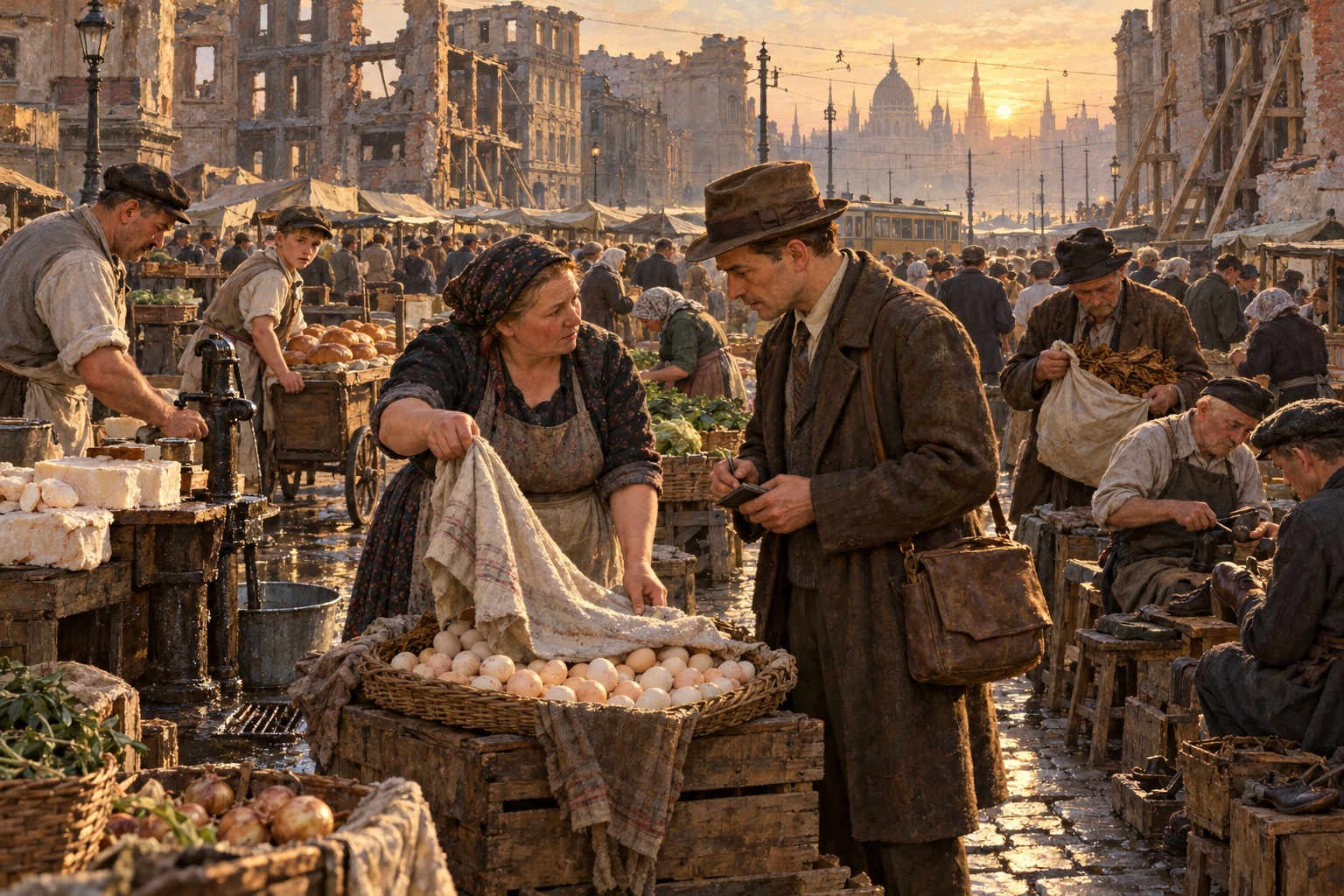
Budapest, Teleki tér, July 1946. Every evening the radio gives tomorrow’s rate through the wall, and every evening it is wrong. Every morning Gyula, who kept a bank’s ledgers for twenty-two years, walks the market, prices the eggs, and chalks the true number on a slate at the end wall, the zeros grouped in threes, and within the half hour the row has it. Then a young man from the economic police comes down the row with a newspaper, asking who wrote it first.
Budapest, Teleki tér, early July 1946, with a coda on 1 August.
The rate came through the wall at a quarter past eight in the evening. The widow next door had kept her radio through the siege by sewing it into a mattress, and now she played it loud enough for the whole landing, because she said a thing that had cost her that much should be used. Gyula sat at his table with the window open and his supper finished and listened to the announcer give tomorrow’s adópengő in the voice of a man reading football scores. The adópengő was the tax pengő, the government’s unit for wages and taxes. Each evening the radio said how many ordinary pengő it would be worth the next day, and the jump from one evening’s figure to the next was the state’s own word on how fast the money was falling.
It was wrong. It had been wrong since April.
He had kept ledgers for twenty-two years at a commercial bank on Nádor utca that no longer existed, and he knew what an index was. It was a basket of prices, taken on a certain day, by certain clerks, at certain shops. It was then carried up a staircase and handed to men who had reasons. The number that came through the wall had been made from yesterday’s eggs and then made smaller on the way to the microphone. Who did it was a question he had stopped asking.
He washed his plate and went to bed with the window open. Next door the radio went on to music.
In the morning he walked his route before he set out the table.
Down Népszínház utca, where half the façades were still propped with timber, and into the square from the corner by the shoe menders. The market was already up. In July it began at first light, when the night shifts came off with their pay, because by evening that money would buy little more than half of what it bought at dawn, and nobody wanted to be holding it then.
Juhászné had her eggs in a flat basket on a crate, under a wet cloth against the heat. She was a big woman from Soroksár who came in on the first train with the eggs in her lap, and then walked from the terminus, and went home on the last one with whatever the eggs had turned into.
“Kezét csókolom,” he said.
“Good morning, Mr. Gyula.” She lifted the cloth for him. She always did. “You heard it last night?”
“I heard it.”
She told him her price. He did not ask her to repeat it. He asked how many she had brought and she told him that too, fewer than yesterday, the hens minded the heat too. He thanked her and went on.
The lard woman by the pump. The baker’s boy with the cart, selling ration bread to people without ration cards. A man with tobacco leaf in a pillowcase. He kept the prices in his head. By the time he came round the square to his own place at the end wall of the row he had the day’s number, and it was half again what the radio had said.
He set up the trestle and the folding chair and the slate, and wrote it on the slate in chalk, with the dollar under it, the zeros grouped in threes as the bank had taught him, so that a man could read it from the pavement without counting.
Within the half hour the row had it.
The Szabó boy came first, as he did every morning. Laci sold cigarettes by the single and changed small notes for anyone who asked. He had been a printer’s apprentice until the printing works went in the siege, and he still had ink in the creases of his thumbs. He put one cigarette on the corner of the trestle without a word, stood back and read the slate with his lips.
It was the only payment Gyula had ever had for the number. He did not smoke. He kept them in a tobacco tin at home, and the tin was nearly full.
“How do you get it?” Laci said. He asked most mornings.
“I go round.”
“I go round too.”
“Then you have it.”
Laci laughed. He was sure there was more to it than eggs, and Gyula did not blame him. The boy went back to his box and wrote the number on a square of cardboard in big round figures, twice the size of Gyula’s, so it could be read from the tram stop, and propped it against his cigarettes. Then he stood beside it and called it out to people going past, so many millions of billions, like a boy selling newspapers. Gyula had never once called it out.
Across the row, Juhászné watched the boy and went back to her cloth.
The shoe menders had it next, and the woman with the second-hand dresses, and the man who sold kerosene from a cart. Nobody said where they had got it. Nobody needed to. Gyula’s number was made of eggs, and everyone in the square had bought an egg.
He changed money until ten.
A tram driver came with his wages from the night shift and wanted dollars, but could not afford a whole one. Gyula sold him a share in one, kept the dollar himself, and wrote the man’s name in the back of his notebook against the share, as he had done for some of them all summer. A woman in a good coat in July sold him a gold napoleon that had been her mother’s and asked him three times to be sure about the rate, and each time he showed her the slate. A soldier back from somewhere in the East, in a uniform with the insignia cut off, changed a little bundle of Romanian notes and was told what they were worth and took it without argument.
At each trade the dollar came out where the slate said it would. The dollar was set every hour by a thousand frightened people.
The young man from the economic police came a little after ten.
He was perhaps thirty, in a clean shirt with a collar too big for it, and he had a notebook and a folded newspaper in his jacket pocket. He came in from the Népszínház utca end and walked the row slowly, stopping at each table, and the market went quiet in front of him and loud again behind. Gyula watched him come. He did not take the slate down.
At the dress woman’s table the detective unfolded his newspaper and held it next to the number pinned to her clothes rail and asked her who wrote it first. She pointed along the row, at nobody in particular. At the shoe menders the same. He came on.
He stopped in front of Gyula’s trestle and read the slate, and then read the newspaper, and then read the slate again.
“Good morning,” he said. “Is this your figure?”
“It is today’s figure.”
“Today’s figure is here.” He turned the newspaper round and showed it to him, a small box on the second page, the number Gyula had heard through the wall.
“That is yesterday’s eggs,” Gyula said. “This is today’s.”
The young man looked at him for a while. He had the face of someone who had been sent to a great many places that summer and had been told the same thing at most of them, and Gyula understood that the young man knew perfectly well what the box on the second page was. He had still been sent to bring someone back.
“There is a difference between the two,” the young man said.
“Yes.”
“Where does it come from?”
“From the eggs.”
The detective wrote something in his notebook. Then he folded the newspaper, put it back in his pocket and went on along the row without saying anything else. Gyula watched him stop at the lard woman’s, and then at Juhászné’s.
He could not hear them. He saw the detective ask his question and Juhászné lift the cloth off her eggs, as if that were the answer. He saw him ask again and look back at the slate. Juhászné looked along the row toward the end wall, toward Gyula, for long enough that he felt it in the back of his neck. Then she looked the other way. She said something short and nodded at the Szabó boy’s box.
The detective went over and read the cardboard and asked Laci something, and Laci laughed, and then stopped laughing. There was a policeman at the corner by the tram stop who had been there all along, eating a roll. He came over when the detective raised a hand.
They took the cardboard and the box of cigarettes and the Szabó boy, and went off toward Népszínház utca. A rate above the official one was price-gouging, and price-gouging had carried a death sentence since the summer before. Everybody in the square knew it was rarely given. Laci looked back once, at his cigarettes in the policeman’s hands, and not at anything else.
The market closed over the space. By eleven the shoe menders had moved a yard to the left.
Gyula sat behind the slate. Nobody asked him anything. A man came with a ring and he bought the ring at the slate’s rate and the man went away satisfied. At half past eleven the number was already behind. He could feel it in the trades. He got up, wiped the slate with his sleeve and wrote the new figure, and within the half hour the row had that too.
At noon he went to Juhászné for his eggs. He bought two every day at noon, at her noon price. She sold him the two and took the money and put it under the cloth.
“He would have taken you,” she said. She said it to the eggs.
“Yes.”
“And then what would we sell by? Laci’s nineteen. They give the young ones less.”
Gyula put the two eggs in his jacket pocket, one on each side so they would not knock. He did not know whether to thank her, and she had not asked him to.
He went back to the end wall. In the afternoon the number moved twice more and he moved it twice more, and the row followed, and at a quarter past eight that evening the widow’s radio came through the wall with tomorrow’s figure, and it was wrong.
On the first of August the forint came.
The new money had lain sealed in the banks for days. That morning it was opened and paid out in wages, in ten-forint notes and coins that rang on the counters. The shops had put their prices up in the night and written them in forints in the windows. At Teleki tér people stood about with the notes in their hands, not spending them.
Gyula walked his route out of habit. Juhászné’s eggs were a price he could say in one breath. The lard woman’s was the same as the list in the grocer’s window on Népszínház utca, and the baker’s boy’s was the same as the lard woman’s.
He set out the trestle at the end wall. Further along the row, where the Szabó boy had sat, a woman was selling plums.
♥ 2026 Paul Titangos · CC BY 4.0 · a story from Good Day Mockingbird № 9