Issue № 1 · Story III
June Gold
Three Junes at the same county fair, fifty-eight years apart, and one watch that keeps its counsel.
1968
The fair came the second week of June, after the asparagus was done and school let out, when the heat settled into the valley for good. It set up on the fairgrounds off Charter Way the way it always did: stock barns at the east end, midway at the west, and between them the long commercial buildings where men sold well pumps and sewing machines and eternity in small monthly payments.
Del was seven. He had four dollars in a fold in his front pocket, and he checked it with his thumb every few minutes the way you check a loose tooth. Two of the dollars were from his birthday and two were from weeding Mrs. Amaral’s beds at a dime a row, and the money had a purpose, which he had told no one.
His grandfather had carried a pocket watch. Del could not have described it. What he remembered was the ceremony of it — the two fingers going into the vest, the gold coming out warm on its chain, the soft click, his grandfather’s face doing arithmetic with the sky. The watch had gone somewhere when his grandfather died, the way things went somewhere, and no one had thought to ask a five-year-old whether he wanted anything remembered.
They walked the fair in the long evening light, his mother fanning herself with the program, his father in his good hat. The flag over the grandstand still hung at half-mast and nobody said why. From the stock barns came the smell of straw and animals, which was the true smell of the fair, under the fried-dough smell that only pretended to be. Cottonwood fluff came off the trees by the canal and drifted across the midway like it had somewhere to be.
The watch man had a stall in the second commercial building, between a knife sharpener and a woman selling cut glass. He was old the way hills are old, with a jeweler’s loupe pushed up on his forehead, and his name, painted on a board, was Levon. On black velvet he had laid out maybe twenty watches, and Del saw the two of them at once, the way you see the two dogs in a yard that matter.
The first had a hunting scene on the case. A stag, antlers laid back, leaping over engraved grass, and behind it trees, and around it all a border of vines. Gold, or gold enough. When Levon turned it in the light the stag seemed to gather and jump. It was, Del understood immediately, the most beautiful thing for sale at the fair, possibly in the county. Something about its shine came to him from far off, from a vest, from two fingers, from a warm click, though he could not have said so.
The other was plain steel, lying open on the velvet: bare lid, white dial, black numbers. It looked like arithmetic.
Both were four dollars.
“That one’s a seven-jewel,” Levon said, tapping the plain one. He said nothing about the stag, which Del noticed and did not understand for fifty-eight years.
His father picked up the hunting-case watch, weighed it, turned it over once, and set it down.
“Tin,” his father said. Just that. His father had come out from Sallisaw in ’36 in a truck he could still describe bolt by bolt, and he had a voice for things that would not last, and this was the voice.
His mother looked at the stag, and then at Del, and smiled in a way that had weather in it. “It’s your money, honey,” she said, in the tone that meant the opposite, the tone with all of Oklahoma still folded up inside it, and she straightened his collar although it was straight.
Del stood a long time. The stag leapt and leapt.
“The plain one,” he heard himself say.
Levon looked at him a moment longer than a sale requires. Then he wound it, held it to Del’s ear so he could hear it running, clicked it shut, and wrapped it in tissue like it was worth wrapping.
“Now that’s a sensible boy,” his mother said to his father, and his father said, “It’s the better watch,” which was as far toward tenderness as the road from Sallisaw allowed. And Del, walking out into the midway lights with the weight new in his pocket, tried the word on — sensible — and found that it fit him like a school shirt, a little stiff at the collar, room to grow.
Behind them on the velvet the stag went on leaping, and shone at the back of his neck all the way to the gate.
1989
The fair still came the second week of June. Del came through the turnstile at ten past six with two kids and a list.
He was the man you handed the list to. Ride tickets for Katie and Sam, a roll of raffle stubs for the church booth, and while he was there he’d swing past the auto building for a fan belt for the Dodge, because Ernie’s had them marked up and the fair man dealt. He moved through the crowd the way he moved through everything now, at the speed of a man whose time is spoken for, and when Sam asked how long till the demolition derby, Del’s hand went to his pocket without his thinking about it, two fingers, the soft click. Ten of seven. “Forty minutes,” he said. The watch had never in twenty-one years asked anything of him but winding.
The second commercial building sold T-shirts now. A kid with an airbrush was painting a wizard on black cotton where the velvet trays had been. Del noticed this the way you notice a tree gone from a road you drive daily — a half-second of wrongness, unexamined, and then the road goes on.
Near the west gate a man had kites. One was a dragon, red and gold, twelve feet of it hanging in the dead evening air, and its scales were painted so that the least wind made them gather and move. It was useless. It would be rags by August. It cost more than the fan belt.
Del slowed. The dragon breathed on its wire.
Sam pulled his hand — the derby, Dad, the derby — and Del looked at the kite one further second, the way you look at a passing train, and said, “I’m coming,” and came.
He got everything on the list. He was home by ten, and the belt fit.
2026
The fair came the second week of June, days shy of the longest one of the year. The light at eight in the evening was the same gold it had always been, lying across the fairgrounds with its arms open, as if no time had passed, as if it were the one thing that had kept all its money.
The fair itself had spent everything. Wristbands now instead of tickets, and the midway rides sang like slot machines, and the food came from trucks with ten thousand followers. The stock barns held on down at the east end, smaller, the 4-H kids sitting with their steers in the straw like the last speakers of a language.
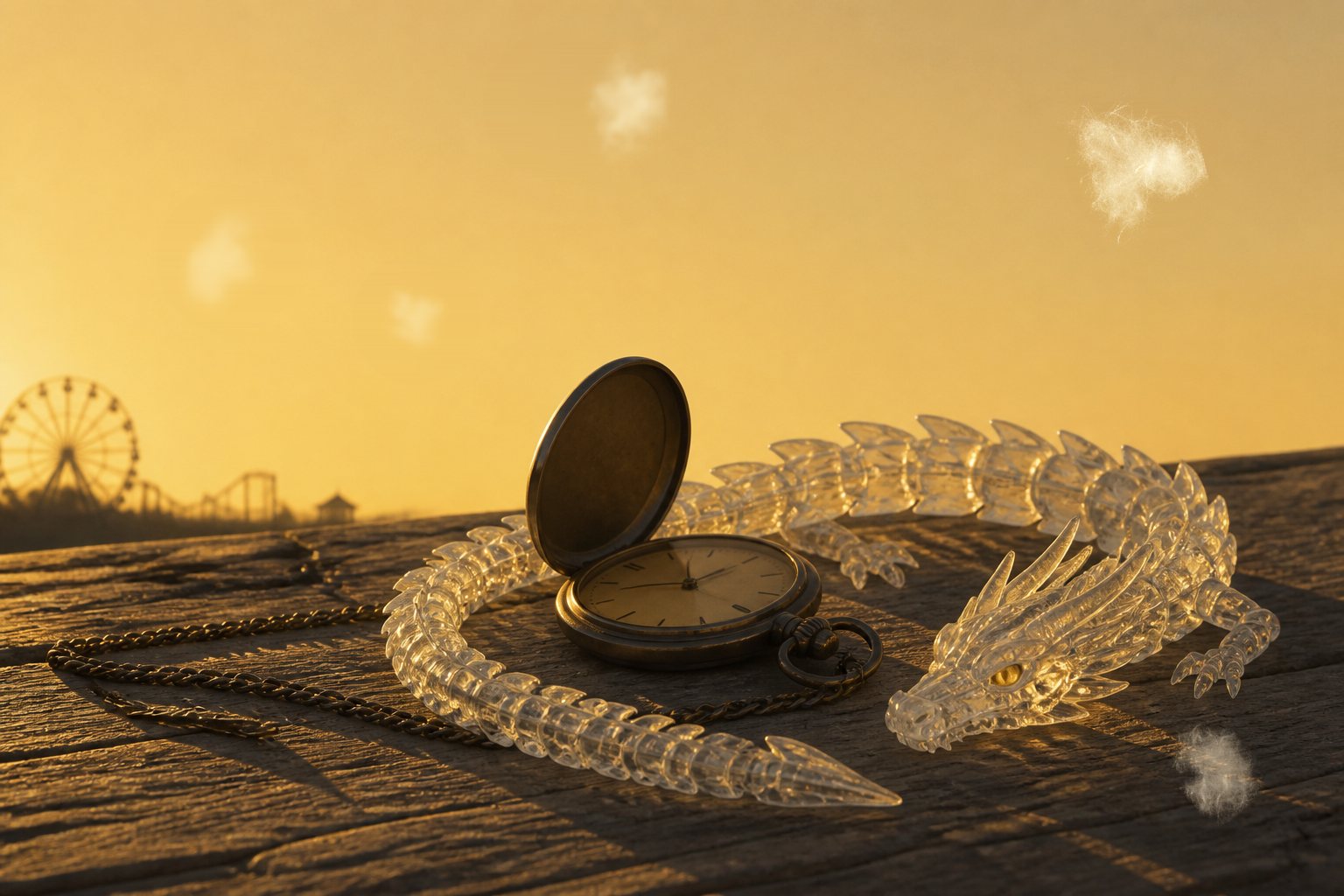
Del was sixty-five and walked at a price he paid in the mornings. He had Eli’s hand in his left hand, and in his right pocket, against his knuckles, the watch. Fifty-eight years. It lost a minute a month, which he corrected on the first, like a man paying a small honest bill.
Eli was eight. He had twenty dollars of birthday money in a nylon wallet with a shark on it, and he checked it with his thumb every few minutes, and the money had a purpose, which he had told no one.
It took them most of an hour to find where the real things had gone. The commercial buildings were bounce houses and solar salesmen, but at the far end, past the last food truck, a barn said COLLECTIBLES & CRAFTS on a banner, and inside it was the fair his body remembered: tables, tissue paper, cigar boxes of coins, men and women old the way hills are old, selling things that had been things a long time.
The dragons were at the end table, where a girl hardly older than the 4-H kids sat beside a small humming machine that was building something pale, line by line, out of one patient thread. Her table was covered with printed animals that moved — lizards, snakes, a scorpion with a curling tail — and in the middle of them, coiled, two dragons.
The first was long as a forearm and printed in something clear as pond ice, its fins thin as paper, its scales laid in overlapping rows down the whole length of it, and when the girl lifted it, it moved the way water moves, all of it at once. Its eyes were gold. The evening light came through the barn door and stood inside it like it lived there.
The second was the same dragon, printed solid: bronze-colored, thick everywhere, joints like knuckles. You could drop it down a stairwell. It looked like arithmetic.
Both were twenty dollars.
“That one,” Eli breathed, meaning the ice.
“This one’s print-in-place,” the girl said, tapping the bronze. “One piece. Can’t hurt it.” She said nothing about the pale one, and Del had heard that silence before.
The old machinery turned over in him, the whole assembly of it — those fins will snap in a backpack, buddy, the solid one you’ll still have when you’re grown, that’s the better — the sentence rising in him fully formed, forty years of fan belts behind it, and it got as far as his teeth.
The light stood inside the pale dragon and did not argue.
Del put his right hand in his pocket. He closed it around the watch, the way a man holds a railing, and held on, and said nothing at all.
Eli counted out his money like a banker. The girl reached for the tissue paper, and Eli shook his head, and took the dragon as it was, alive in both hands.
They came out into the last of the light. Over the grandstand the flag stood straight out, full-mast, in the delta breeze that arrives on June evenings like a payment. Somewhere down the midway a ride sang. Cottonwood drifted across from the canal, unhurried, the way it had drifted in 1989 and 1968 and, for all Del knew, across the tule fog of every year before him and every year to come.
In the open midway Eli stopped, and held the dragon up over his head in both hands, into the breeze, and the wind went down it scale by scale, the whole shining length of it moving without going anywhere, and the dragon breathed.
“Grandpa, watch,” Eli said, meaning the dragon, meaning everything.
“I’m watching,” Del said, and he was.
The watch ticked against his hand, keeping its minute-a-month, holding what it held. The days were three short of their longest. After that, though no one at the fair could feel it yet, the light would begin, in its patient sensible way, to shorten. Del knew it the way you know a thing you have carried a long time. He kept it in his pocket, and walked his grandson and his dragon out through the gate, into all that gold.
♥ 2026 Pete Kaminski · CC BY 4.0 · a story from Good Day Mockingbird № 1