Issue № 1 · Story II
The Hour Merchants
A market appears in Harlan’s field one Monday night. It buys and sells only one thing, and only your own stock.
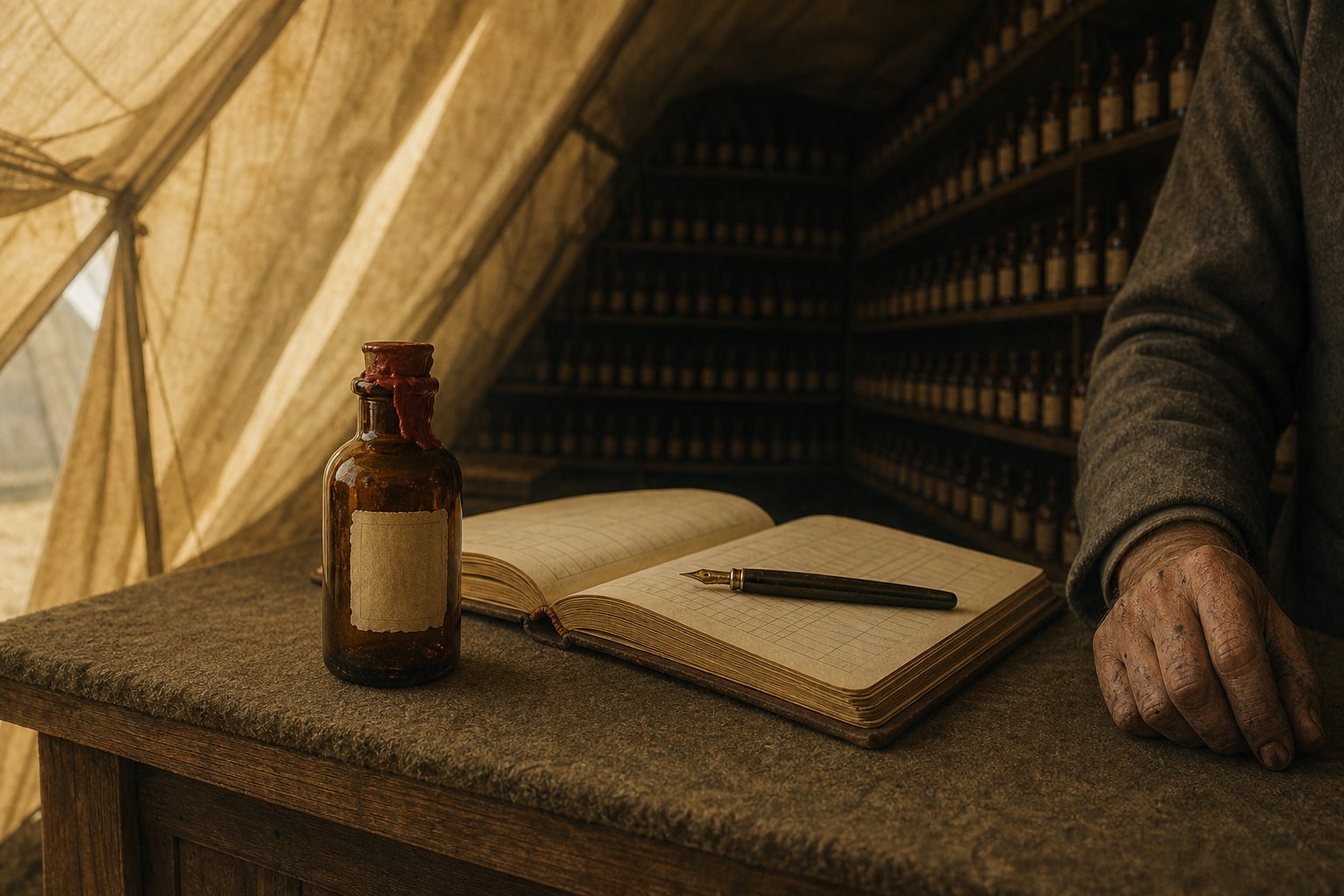
The market arrived on a Monday night the way weather arrives, without permission. By morning Harlan’s field had rows of stalls in it, canvas the color of moths, ropes already weathered, as if the whole thing had stood there for years and the town had only just noticed. There was not one clock anywhere on the grounds. People noticed that later than they should have.
The sign at the gate was hand painted and modest. BOUGHT AND SOLD: HOURS. FAIR PRICES. Underneath, smaller: YOUR OWN STOCK ONLY.
Nobody understood it until Gus Tillman went in, because Gus would go into anything. He came out an hour later looking like a man who’d been crying in the good way, and by supper the whole town knew how it worked.
You went to the long counter and a clerk asked you one question, which was not what but when. You gave the when as best you could. The clerk went back among the shelves, which ran deeper than the tent could possibly hold, and came back with a small amber bottle, wax sealed, labeled in a hand nobody could read. You took it to the tasting tent, broke the wax, and breathed it in.
Then you were there. Not remembering it. In it.
Gus had asked for an afternoon in July of 1987. Nothing happened in that hour and that was the point. Lois was alive and hanging sheets on the line and the radio was doing a ball game low through the kitchen window, and Gus was on the back step with a glass of tea sweating in his hand, and for one entire hour that was the whole world again, every fly and breeze of it.
You couldn’t change anything. That got asked a lot the first day. You were yourself in the hour, the same self, saying what you’d said, doing what you’d done, and you knew it the whole time, the way you know things in certain dreams. Somehow that made it better instead of worse. Nobody had to be responsible for the hour. They only had to be in it.
The price was the strange part. The merchants didn’t take money. You signed the ledger, and the line you signed said: One (1) hour, forward stock, collected at the house’s discretion.
People laughed at the wording. Then they signed.
By Wednesday the line ran halfway down the field. The merchants worked it without hurry, gray coated, polite, tired in the eyes the way pharmacists get. They answered questions but never volunteered anything. Could you buy an hour of someone else’s? No. We only stock your own. Could you find out which hour they’d take in payment? The clerk would look at you then, not unkindly. Forward stock, the clerk would say, as if that were an answer.
The town went soft and strange that week. You’d see it at the diner, whole tables talking in the past tense, people coming in dazed and tender with their eyes rimmed pink. Marcy Deel bought the same hour four times, her boy at seventeen months asleep on her chest during the big power outage, the house dark and warm and his breath on her collarbone. Four bottles, four forward hours. Nobody said a word to her about it. The teenagers bought hours from last summer, which everybody over forty found hilarious, and the merchants sold those too without comment. The house did not editorialize.
Pastor Boyd preached against it on the first Sunday, before the market even opened for the day. Covetousness of one’s own life, he called it. Monday he was in line like everyone else.
Nell Prentice held out the longest.
Nell ran the hardware store and had a reputation for being the sensible one, which is a job somebody has to do in a small town and which pays nothing. She stood at her register all week telling people it was a bad trade on its face. An hour you already had for an hour you haven’t. You’re paying interest to borrow from yourself, she said, and people nodded and went and stood in the line anyway, and honestly she didn’t blame them. She just thought somebody ought to say it out loud.
Her mother was out at the county home. It had been six years since her mother last called her by name. Nell drove out Tuesdays and Fridays and sat with her, and her mother watched her the way you watch weather on a television, mildly, from a distance, waiting for it to be about something.
Thursday, Nell closed the store early.
The clerk at the counter had ink stained fingers and did not look surprised to see her, but then he didn’t look surprised to see anyone.
“When,” he said.
“August. Nineteen ninety… eight,” she said. “A Sunday. There was a porch and there were peas.”
He didn’t ask which Sunday. He was gone a long moment among the shelves, longer than for most, and came back with one bottle, small as a plum, heavier than it looked.
“Is this it?”
“It’s the one you mean,” he said.
She signed the ledger. One (1) hour, forward stock, collected at the house’s discretion. Her hand only shook a little.
The porch. Lord, the porch. The gray paint going in front of the rocker where her mother’s heels had worn it, and the colander between them on the boards, and the peas. Her mother’s thumb splitting pods in one long practiced motion, three peas, four, the ping of them in the metal. The radio doing a ball game low, always a ball game, always low. The neighbor’s sprinkler hissing on a timer her mother disapproved of at length, because who waters at four in the afternoon, you’ll scald the grass, Nelly-bird, you might as well pour the water down the storm drain and cut out the middleman.
Nelly-bird.
Nothing happened in the hour. That was the whole hour. Her mother sang the wrong words to something twice and got mad at a crow and told a story about a cousin that Nell had heard sixty times and would have paid anything, anything, to hear a sixty-first. Her own hands were small in the hour, and quick, and stained green at the thumbnail. The peas went ping. The light went long. The hour ended the way hours end, which is to say she didn’t feel it go until it had gone.
She sat in the tasting tent a while after. The merchants let people do that. It might have been the kindest thing about them.
The market packed out Sunday night. Nobody saw it happen, which was itself odd, since half the town had privately planned to watch. Rhoda Pike set a lawn chair at the gate at dusk and woke in it at dawn with a blanket over her that she did not own. The Deel boys parked their pickup truck on the shoulder with a thermos and both swear they never slept, and both remember nothing between full dark and first light. Earl Mott got a phone call that kept him exactly long enough, though he can’t now say from whom. Nobody’s story held together, and nobody wanted to look at that too closely, not yet, and not in front of each other. Monday morning Harlan’s field stood empty, and the grass stood straight up, unbent, as if nothing had rested on it all week, which felt to a lot of people like a kind of insult. There were no tire tracks. There was one small amber bottle in the ditch by the gate, empty, which Gus Tillman took home and put on his windowsill and never explained to anybody.
The collections began about two weeks later.
Here is how it felt, as near as the town could ever agree. You didn’t black out. You just weren’t there for the hour. You came to yourself at the far edge of it, standing wherever your body had taken itself, with an hour shaped nothing at your back. Whatever had happened in the hour had happened without you in attendance. Your body kept the appointment. You didn’t.
Carl Dunphy lost his hour standing in line at the county clerk’s office and called it the best deal of his life. Marcy Deel lost one of her four somewhere inside a night’s sleep, she thinks, she can’t even find the seam. The teenagers mostly can’t tell you what they lost, which everybody over forty finds less hilarious than they expected to.
Pastor Boyd lost the hour of his own sermon. He came to himself at the door shaking hands. The congregation says it was the finest he ever preached, and there’s a faction that wants it typed up from Eleanor Fitch’s shorthand, and he won’t allow it.
And Dale Barrow, who manages the bank, lost the one hour his daughter was ever going to be at our airport. Her connection out of Denver, a fifty minute layover, the only time her feet would touch ground within two hundred miles of him all year, and he’d driven up just to stand at the glass and wave at her through security like a fool, he’d told everyone, like an absolute fool, and he was glad to be one. She says he was there. She says he stood at the window the whole time and didn’t wave and didn’t smile and wouldn’t turn around when she called his cell, just stood there with his hands at his sides like a man watching weather. He doesn’t remember any of it. He has the parking stub.
That was when the town understood what the fine print had cost, and understood something else too, slower, the way you feel a bruise the day after. The house had a taste for exactly the stock the town had been buying. It didn’t take weddings. It didn’t take births, or deaths, or the hour of anybody’s diagnosis. It took ordinary hours, unremarkable ones, an hour of sleep, an hour in a line, an hour at a window. Nothing important.
That was the whole price. Nothing important. The town had spent a week learning what those hours were worth on the open market, and then it paid in kind.
There was talk, afterward, the way there’s always talk. Somebody’s cousin over in Deene said the market had come through there in his grandfather’s day and never since. Somebody else said you could still refuse collection if you caught it starting, if you bit your own tongue hard enough, which nobody believed and several people have privately resolved to try.
Nell’s hour hasn’t come yet. As far as she can tell. She’s checked the seams of her days the way you’d run a thumb along a hem, and it’s all still hers, so the debt is still out there, forward, at the house’s discretion.
She’s arranged her life about it in a way she doesn’t discuss at the register. She goes out to the county home Tuesdays and Fridays still, but she stays the whole hour now, the full sixty minutes of it, and she’s started bringing peas when she can get them, because her hands remember the motion and her mother likes to watch. Thumb down the seam, three peas, four, ping in the colander. Her mother watches her hands the way she’d watch a radio, waiting for it to be about something. Sometimes she hums the wrong words to things. Once, not since, she said Nelly-bird, or something bird, or something.
Any hour could be the one she owes. Nell has decided that’s the house’s problem and not hers. She shells peas on a porch in August with her mother beside her, and pays attention, which as far as she can tell is the only currency the merchants ever really dealt in. And if they come for this hour, this exact one, then let them come.
They’ll be getting the best thing on the shelf.
♥ 2026 Claire Jacobs · CC BY 4.0 · a story from Good Day Mockingbird № 1