Issue № 1 · Story I
Test Pattern
A television dealer in Hamilton County, Nebraska, a carnival two blocks down, and the one week a year the two of them share a street.
The man from Commercial Credit Corporation came into the store at ten past five with a clipboard and read serial numbers off the backs of eleven television sets while Harold Pettibone held the flashlight. Nine Philcos, two Crosleys. The 21-inch console in the window, mahogany veneer, $299.95 on a card tented atop the cabinet, was number eleven. The man made his ticks, said the curtailment on the two carryovers was due the tenth, said it was a hot one, and drove back toward Grand Island.
The carnival had come through at noon. Eleven trucks off the highway, down Twelfth toward the fair lot, diesel and banner paint, and Harold had stood at the register with a sales book he wasn’t using and let the smell come in through the propped door and do to him whatever it was it did — something he would have been embarrassed to describe and didn’t try to.
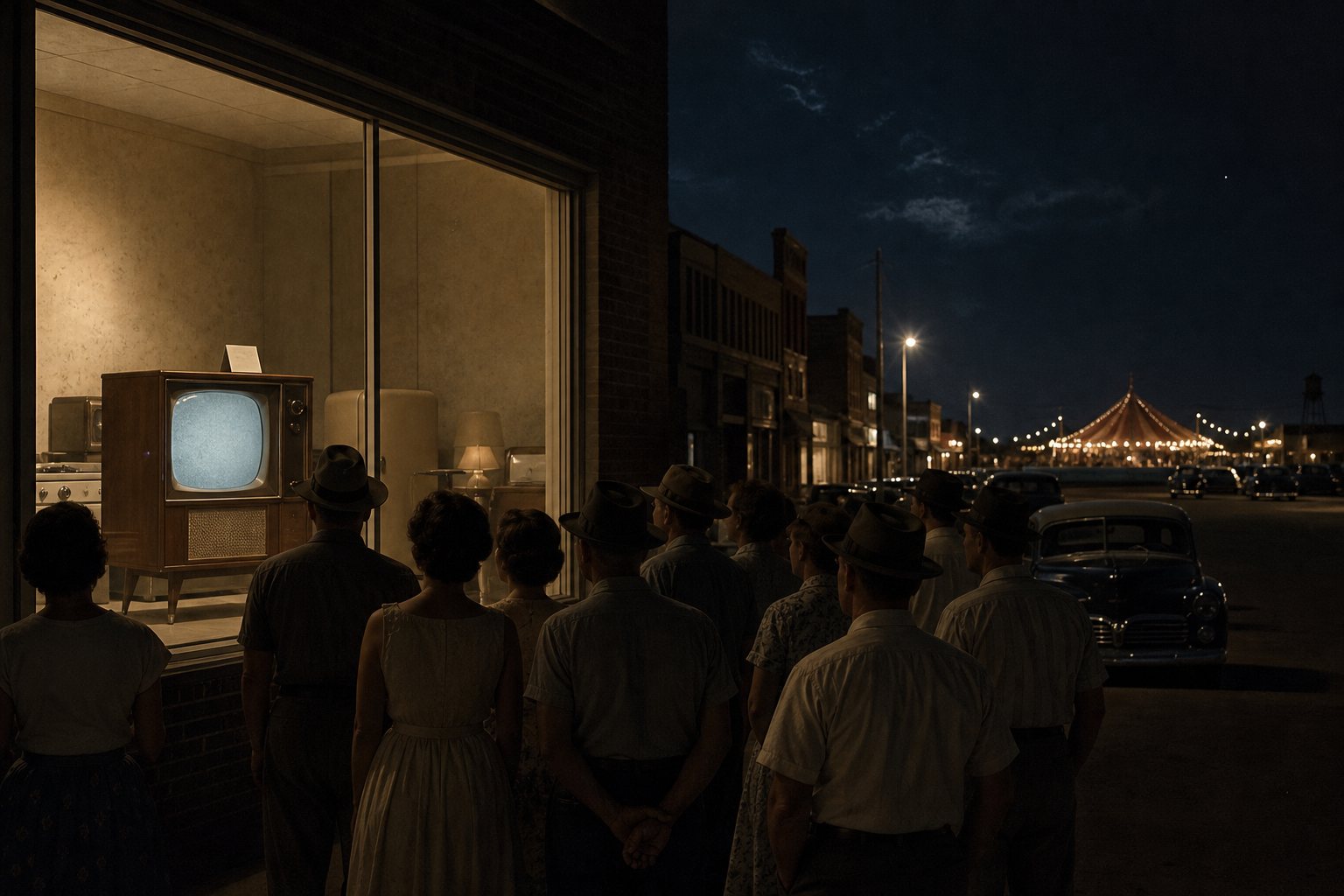
By eight there were forty people on his sidewalk. He counted them from behind the counter, the way he counted stock. The set in the window ran from six to sign-off with the sound piped through a speaker over the door — a paper-cone Utah eight-inch he had wired himself — and channel 10 came down out of the antenna on the roof clean as tap water. Sixty-one feet of mast, tallest in Hamilton County. Jack had climbed it in the fall of ’51, seventeen years old, taking the guy wires up one-handed, and Jack was in Lincoln now selling casualty insurance and closing four calls out of five, which was a percentage Harold had never once hit on the floor beneath his own roof.
Wrestling out of Chicago. Forty faces going blue and silver. Merle Otradovsky, who farmed a quarter section toward Marquette, stood at the glass a long while with his hat off, reading the card on the cabinet, and said to nobody, “Two hundred bushels,” and put his hat back on and went on watching.
Grace came down at nine with iced tea and stood beside him at the counter and looked at the backs of the crowd’s heads.
“Folding chairs,” she said. “Coffee urn. Nickel a head. Harold, they’re standing in the gutter.”
“No,” he said.
“Tell me why not.”
He couldn’t, and she knew he couldn’t, and she didn’t press it, which was among the reasons the marriage was a good one. She went back up, and that was the argument, all of it, the same as it would be every night that week.
Two blocks south, under the strung lights, a voice was working. From inside the store he couldn’t make out the words. Just the shape of them, rising and falling, the way a signal looks on a scope before you can say what’s riding on it.
Thursday the talker came in for a fan.
Harold knew him before he knew him — city hat, good shoes gone to dust at the welt, a voice that filled the store the way the speaker filled the street. Something for the top of a ticket box, he said. Harold showed him the Westinghouse oscillating at $13.95 and a Dominion at eight and a quarter, and told the truth about both, which was that the Dominion would do fine.
The man bought the Westinghouse and stayed an hour.
They talked shop. Routes and weather. The man had played Grand Island and Hastings, and said Hastings was a quarter town pretending to be a dime town and Aurora was the opposite, which Harold turned over for days afterward without deciding whether he’d been complimented. Harold talked reception — skip and snow, and how the affiliations had shuffled all year so that half the county no longer knew what was on when. He knew. Men stopped him at the elevator to ask, and it earned him nothing. The talker nodded at that like a doctor.
He asked what the mast had cost. Harold said the steel or the labor, and the talker laughed, and Harold said his boy had put it up, and the talker said, “Then you’ll never take it down.” He looked a moment at the console running its afternoon slide, the Indian head sitting in its frame of mahogany, and said nothing further about it at all, and neither did Harold, and both of them heard everything that wasn’t said, the way two men in the same line always do.
In 1948 a distributor in Grand Island had offered Harold the service manager’s desk, territory to the Colorado line, on the strength of nobody else being able to fix the things. He had turned it down for sound reasons. He had not thought of it in some time and did not exactly think of it now.
The talker paid cash off a roll, thirteen ninety-five, and carried the fan out under his arm like a ham.
He never came in again. On the sidewalk each night after, among the hats, Harold found himself reading faces longer than counting required.
Friday he told Grace he wanted to walk, which was true.
The quarter he put down at the tent door was the first money he had handed a stranger in he couldn’t have said how long. The register ran the other way; that was the whole trade, money coming toward you across a counter. Here was his own quarter going out into a canvas twilight that smelled the way the trucks had smelled, and his ears went warm.
Inside, nothing had a price on it.
He moved with the tip past a platform where a man folded himself into a bushel crate, past a fat lady in a pink dress doing needlepoint and not looking up, and stopped where everybody stopped.
She sat at a felt-topped table beneath her banner and she had no arms at all, and she was writing. Copperplate. The pen held between the first and second toes of her right foot, the ankle turning through the loops the way a wrist turns — better than a wrist — the line coming off the nib fine on the upstroke and swelling on the down, exactly as the old penmanship charts said it should and almost nobody’s ever did. She would write your name on a souvenir card for a dime. She asked his name without looking up from the card ahead of his, and he said, “Harold,” and watched her make it.
He had spent twenty years with the backs off of things. He knew what a trick looked like from the wiring side. There was no wiring side. There was a woman who had put in the hours — more hours than he had put into anything — and a card that said Harold in a hand like an engraving, and she told him to blow on it, and he did.
Vernon Slack from the co-op was in the tip near the flap. Their eyes met, and Vernon nodded the way you nod in church, and neither of them said anything then or ever.
Harold walked home the long way, past the elevator, the card carried flat in his shirt pocket like a license.
Saturday night he came around the counter and out the propped door and stood on his own sidewalk in the crowd, which he had not done all week, and watched his window the way a customer would. The picture was good. He knew why it was good — knew it in microvolts and feet of mast — and standing in the gutter with his neighbors he understood that not one of them cared why, any more than they cared what made the corn come, and that this was the correct way to care about it.
From two blocks down, in a lull, the voice came up the street entire, the only time all week the words arrived whole:
“Alive — alive — she’s alive, livin’, and breathin’, friends, not a picture, not a picture show, not wax nor plaster nor a trick of the light, but flesh and blood on the inside of this canvas, alive this minute the same as you and me, and for one quarter of one dollar — one twentieth part of five — you will say for the rest of your natural life that you saw her —“
Then the crowd noise closed over it, and on the screen a man in Chicago threw another man in Chicago into the ropes, and forty people in Aurora leaned.
Harold stood among them with a card in his pocket and did not go back inside for a long while.
Sunday morning Jack called from Lincoln at eight sharp, the way he did. He had written four policies that week and closed a fifth Saturday over pie. He asked was the fair in, and Harold said it was. Jack said, “Put out chairs, Pop, charge a dime,” laughing, not knowing he was quoting his mother, and Harold laughed too and said business was fine, which on paper it was.
The trucks loaded out sometime in the dark hours between. He didn’t watch them go.
Sunday night the crowd was thinner — a dozen, then eight. Grace went up at ten. Harold stood behind the glass with the store lights off, so that to the street he was nothing but a shape behind a shine.
At sign-off the announcer in Lincoln read the transmitter data, and the flag came up, and the anthem played through a paper-cone speaker to eight people on a sidewalk in Hamilton County, some of them with their hats off. Then the test pattern: the Indian head in his circle, the steady tone under it.
Harold had it worked out by then, or believed he did. He stood turning it over the way he’d turn over a chassis fault, and it came clear, and he was satisfied with it: the tent had to tell you it was alive — had to shout it down two blocks of a summer street — because it was leaving. Because by Monday it would be a mowed field and a smell. The box never had to say anything. The box was true. That was Lincoln in there, this minute, an actual man reading actual words forty-five miles away, and nobody has to bally what is really so. That was why they stood. He was sure of it, and it fit together like a schematic — and he had had the back off that cabinet a hundred times and knew to the last pin that there was nothing inside it at all, and the one thing on the premises with breath anywhere near it was a dime card in his shirt pocket, written by a foot, in a hand nobody would ever teach again. None of that made it into the sum. It didn’t fit, and a man balancing his accounts leaves out what doesn’t fit.
He left the set on.
Out on the walk the eight stood looking at the pattern — the circle, the head, the wedges made for measuring things — nobody selling them anything, nothing coming next. They stayed anyway, the better part of five minutes, before the first hat turned away.
♥ 2026 Paul Titangos · CC BY 4.0 · a story from Good Day Mockingbird № 1